
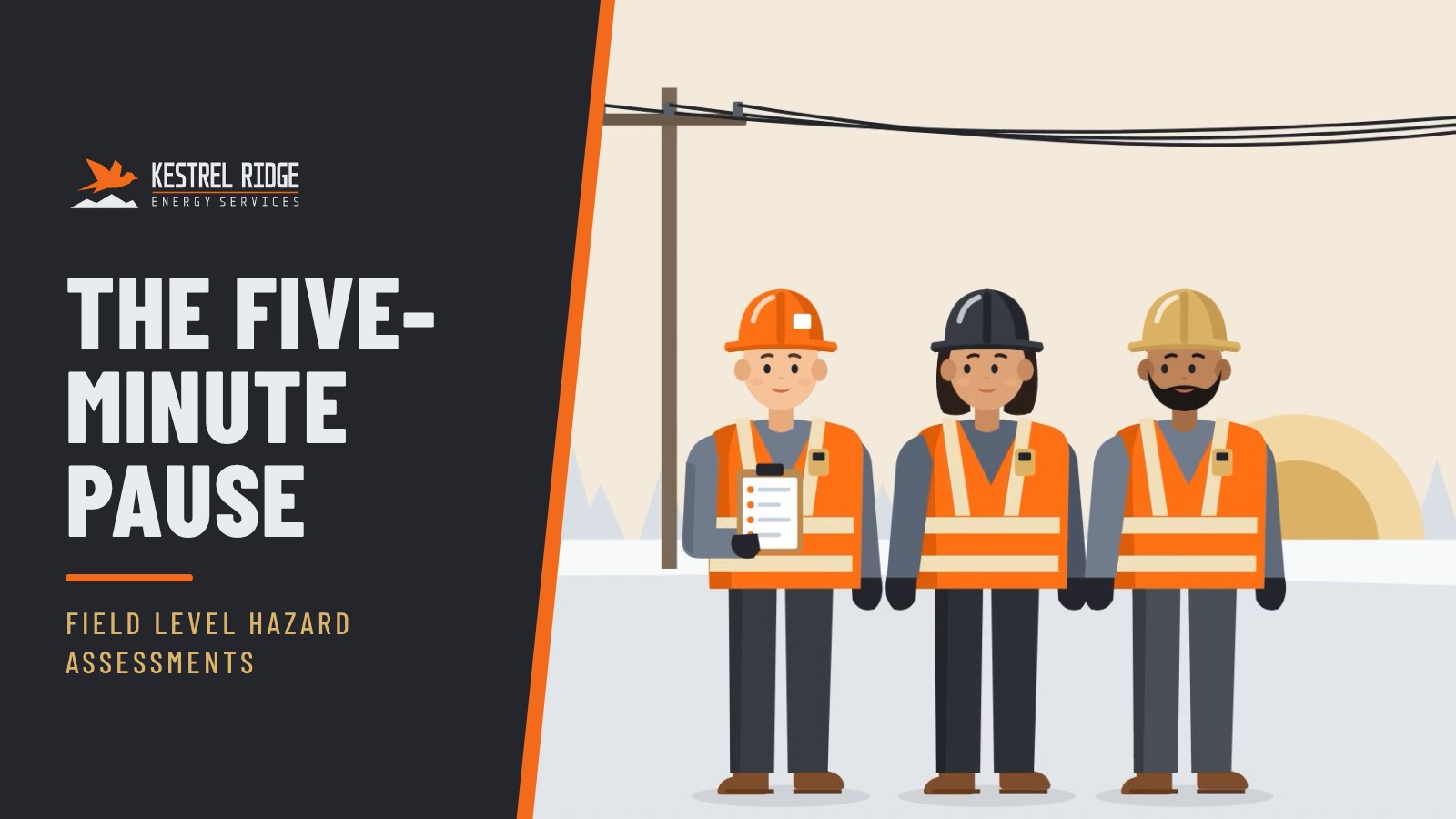
The brief
Oilfield service crews change with the season, and new hands arrive who have never worked a lease. They want to keep pace with the crew, so the Field Level Hazard Assessment (FLHA) becomes a box to tick, or gets done once a shift and forgotten. The course needed to make one habit stick before every task: stop, look, talk, and only then pick up a wrench.
What learners can do after
- Complete an FLHA before every task, not once a shift
- Scan a work area in three directions: up, around and down
- Raise a hazard or call a stop, however new you are
- Apply controls in order: eliminate, guard, then PPE
- Recognise when conditions change, and redo the FLHA
The framework
Five steps, one per word, so a new hand can recall them in the cold with gloves on. The last step loops back to the first whenever conditions change.

-
1
Stop
Don't start the task until the FLHA is done.
-
2
Scan
Walk the area: overhead lines, pressure, H2S zones, ice, traffic and wildlife.
-
3
Speak
Read the FLHA to the crew. Anyone can raise a hazard or call a stop.
-
4
Control
Eliminate the hazard, guard what you can't, and use PPE as the last line.
-
5
Sign
Everyone on the task signs. Redo it when the wind, weather, crew or job changes.
How the course was designed
Who it is for, what each objective is taught by and tested with, and the decisions behind it.
New oilfield service hands, often in their first season.
On a phone in the crew truck or at the yard, gloves nearby, between jobs.
That an FLHA exists. Not why it is redone for every task.
Pen before wrench, every task, and call a stop when conditions change.
Every objective has a scene and a question.
Pick one to see where it is taught and how it is tested.
Four design decisions
What we chose, and why. Timestamps point to where each one shows up.
- 1:11
Make the pause the job, not a delay.
The narrator returns to one line until it sticks: "Those five minutes aren't a delay before the job. They are the job."
- 2:03
Let the learner catch the miss.
Jace walks past the ice, and the video stops to ask which hazard he missed, before anyone points it out.
- 3:22
The new hand calls the stop.
Forty minutes in, it is Jace, not the foreman, who raises his hand. New hands see that calling a stop is their job too.
- All
Built from layers, not a shoot.
Flat screen-print illustration in hi-vis orange and graphite. A new site, task or season is a scene swap, not a reshoot.
From the HSE procedure to words crews use on the lease.
Rewrite rules: One step per word; "hierarchy of controls" becomes "eliminate, guard, PPE"; "revalidated" becomes "do it again"; every line names a thing you can see on the lease.
An FLHA shall be completed and signed by all personnel assigned to a task prior to commencement of that task.
Pen before wrench. No task starts until the hazard assessment is done.
Assessments shall address hazards above, at and below the work area…
Walk the work area before you touch anything, and look in three directions.
Any worker may initiate a stop-work action.
Anyone on site can raise a hazard, or call a stop. Including the newest person here.
The FLHA shall be revalidated where weather, personnel, scope or site conditions change.
When the wind, the weather, the crew or the job changes, the hazard assessment is stale. Go back to Stop.
Read the full source passage
HSE-PRO-07: Field Level Hazard Assessment. An FLHA shall be completed and signed by all personnel assigned to a task prior to commencement of that task. Assessments shall address hazards above, at and below the work area, including energised overhead conductors, pressurised systems, H2S exposure zones and ground conditions. Hazard controls shall be applied in accordance with the hierarchy of controls: elimination, engineering controls, administrative controls and personal protective equipment. Any worker may initiate a stop-work action. The FLHA shall be revalidated where weather, personnel, scope or site conditions change.
Sample source text written by ADC for this concept course. Kestrel Ridge Energy Services is a fictional brand.
Try the knowledge check
Two checks pause the video at the moment of decision, and the third runs in the LMS quiz afterwards. In your LMS, the score is recorded automatically through SCORM 1.2.
How a client would know it worked
The measures we recommend tracking after launch. A measurement plan, not results: concept courses have no learners yet.
Completion before first lease day
Every new hand finishes before the truck leaves the yard.
Score on the in-video checks
A low Scan score means the ice moment needs a refresher.
FLHAs per task
Supervisors audit forms: one per task, not one per shift.
Stop-work calls by new hands
Expect these to rise. Speaking up is the target behaviour.
What a client would receive
- SCORM 1.2 package with the scored knowledge check
- MP4 master in 1080p
- Caption files (SRT and VTT)
- Full transcript
- Quiz questions and answers in an editable document