
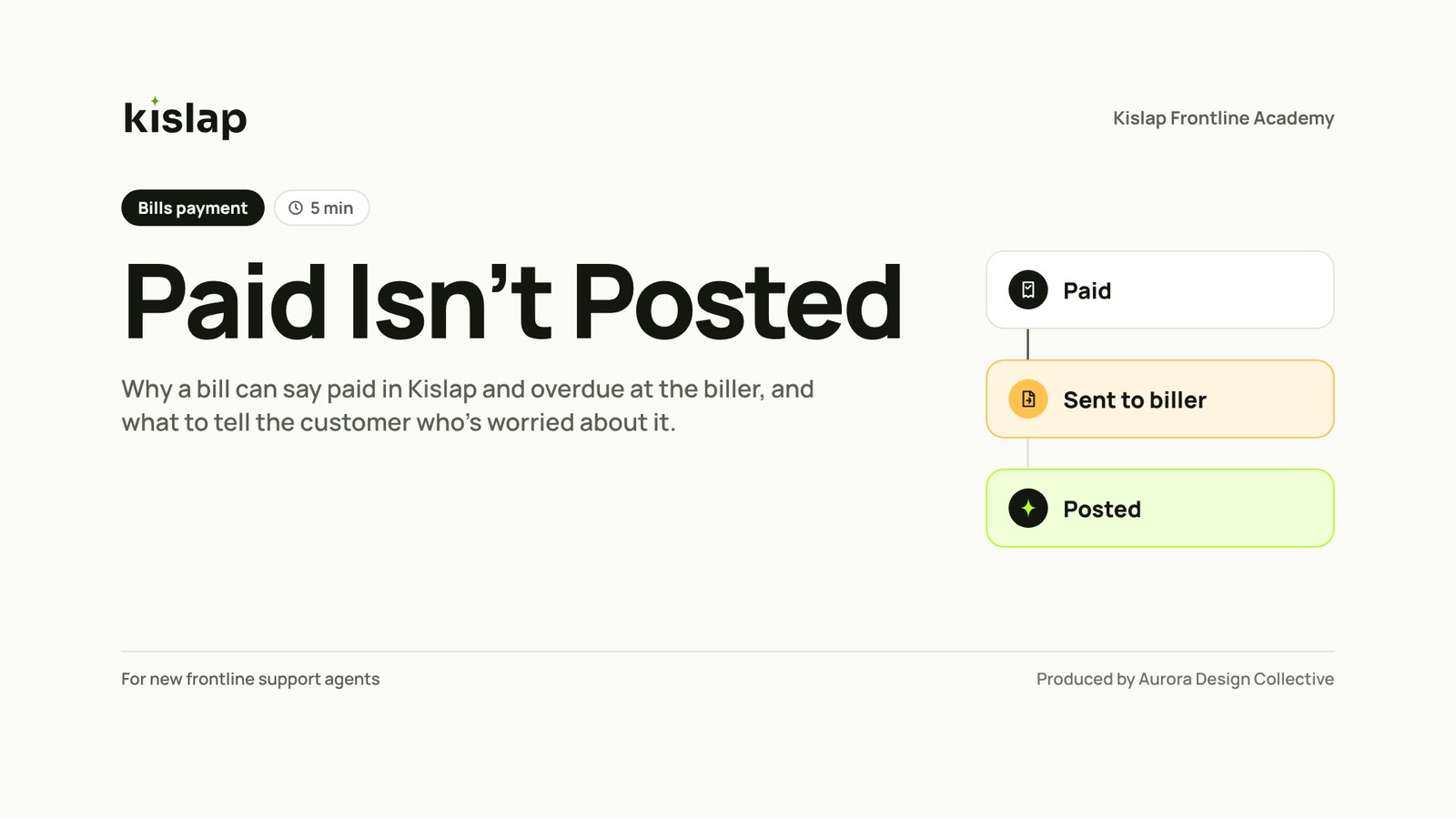
The brief
Customers panic when a biller says "overdue" after they've paid, especially when their power or water is at stake. New agents either over-promise or blame the biller. The course needed to show where a bill payment really is, and how to reassure with proof and a date.
What learners can do after
- Explain why "paid" in Kislap doesn't mean "posted" at the biller
- Name the three stages of a bill payment and place one from the record
- Work out the expected posting date from the biller's file schedule and cut-off
- Tell an entry error from a payment that is still processing
- Reassure with proof and a date, and escalate once the posting window has passed
The framework
A bill payment moves through three stages, and the biller, not Kislap, sets the clock for the last one.

-
1
Paid
Kislap takes the payment and issues the receipt.
-
2
Sent
The collecting partner sends it to the biller in the next daily file.
-
3
Posted
The biller applies it to the account, within its own posting time.
How we built it
One case runs the whole course: Tess, who runs a small store, pays her electric bill at 9:42 PM, after the biller's 8 PM cut-off, the night before it's due. Two days later she gets an "overdue" text. Learners follow her payment through all three parties and stages, then learn the five common causes and how to tell an entry error from a payment that's simply waiting.
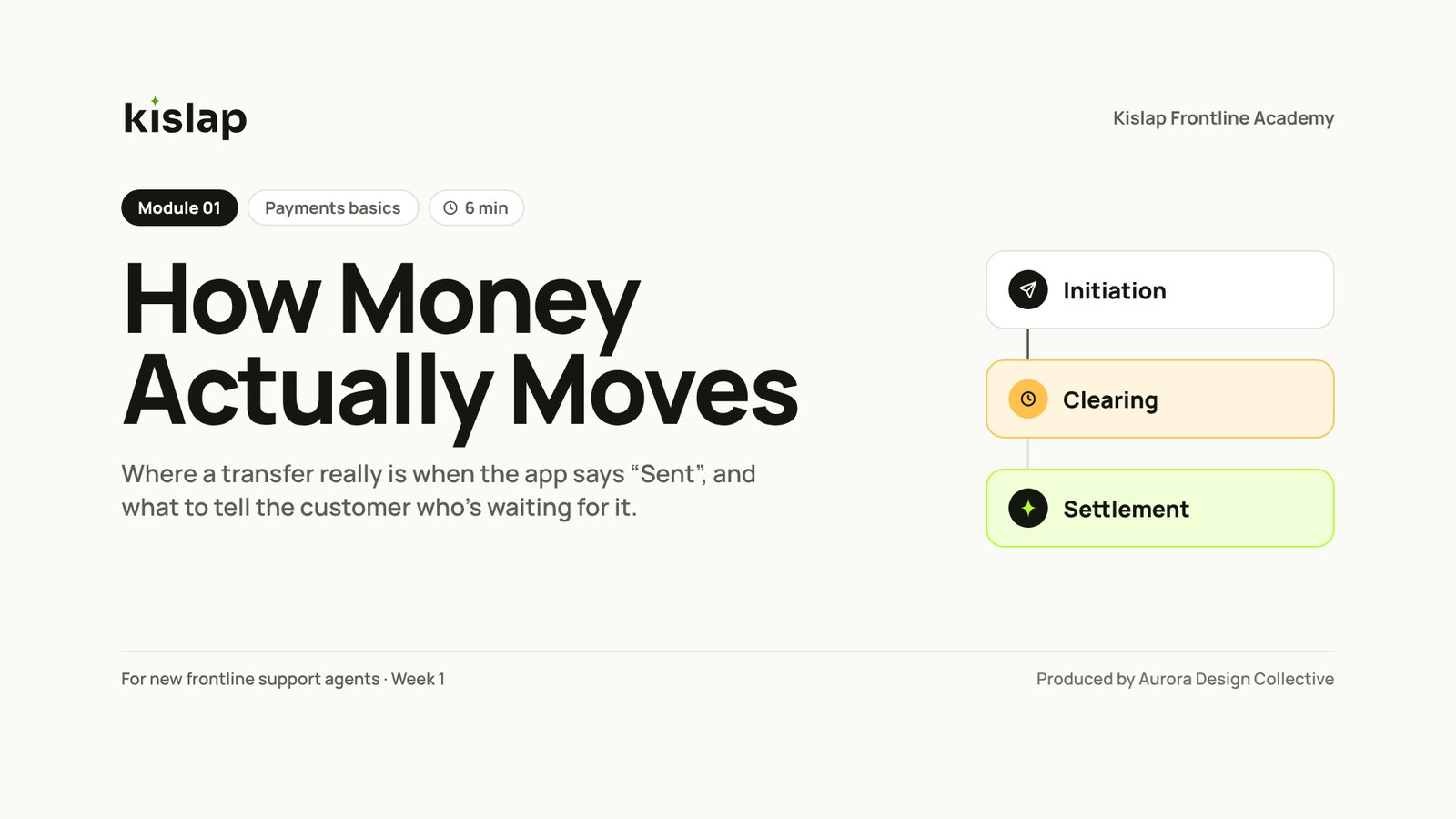
It reuses the design system and teaching templates from How Money Actually Moves, so a second module costs far less than the first.
- 1PaidQ3
- 2SentQ1
- 3PostedQ1Q2
Try the knowledge check
Three scored questions with new scenarios, so agents have to apply the rule rather than recall the story. In your LMS, the score is recorded automatically through SCORM 1.2.
What a client would receive
- SCORM 1.2 package with the scored knowledge check
- MP4 master in 1080p
- Caption files (SRT and VTT)
- Full transcript
- Quiz questions and answers in an editable document